
SRA Annual Report 2025-26: Building Local Resilience
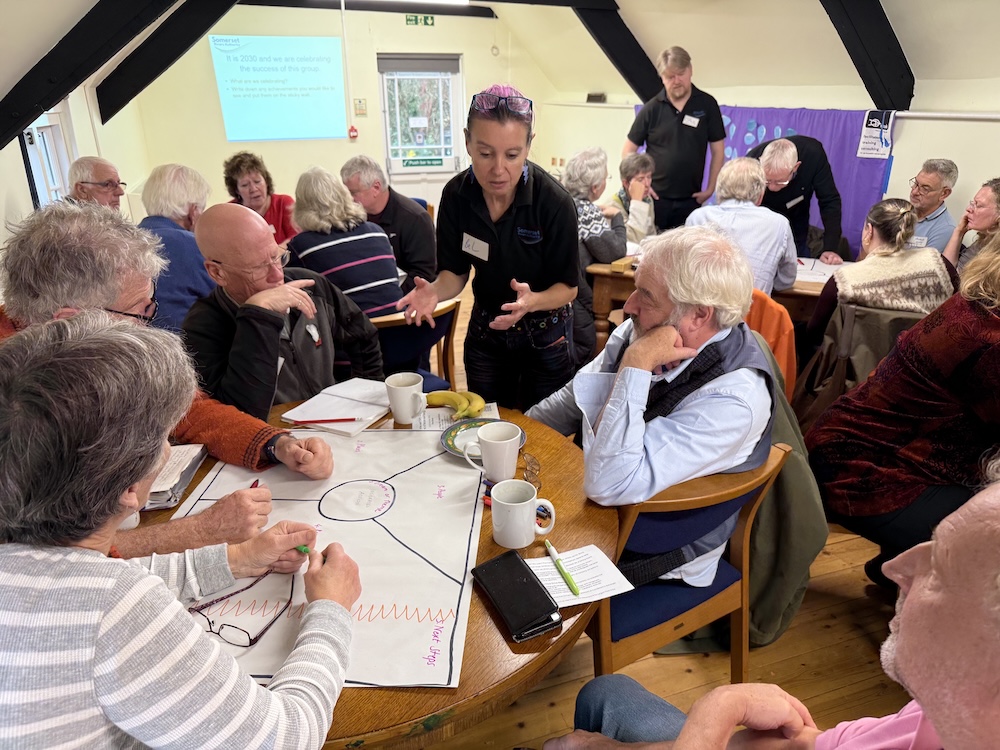
This workstream helps to deliver the SRA Strategy by concentrating mostly on ‘working with communities’ and ‘building resilience, encouraging adaptation’. The aim is to foster better understanding, collaboration and preparation across catchments. Individuals and communities say they value being able to do three main things. Firstly, understanding and monitoring the various flows of water through the landscapes in which they live. Second, helping to reduce their own future flood risks. Third – if floods do occur – being able to act, having acquired some requisite mix of knowledge, training and equipment.
Hence the activities of the SRA’s community team, Dr Bel Deering and Dr Paul Elliston. In 2025-26 they led or took part in:
- 10 training sessions and workshops
- 24 flood group and flood group network meetings
- 3 Somerset Prepared community resilience roadshows
- 48 community visits
- 1 business resilience event
- 11 school visits
- 76 public events
- 18 Local Community Network and town and parish council meetings
In total they had 4,856 meaningful conversations about flood-related matters.
Every number above represents a multitude of stories. For example, the SRA’s community team took leading roles in organising the annual Somerset Prepared Community Resilience Conference. Held in November, this event drew around 190 people to Taunton Racecourse. Attendees enjoyed an opening talk about flooding from Clinton Rogers (one of Somerset’s Deputy Lord-Lieutenants) and took part in interactive sessions about aspects of community resilience. Sessions led by the SRA covered riparian rights and responsibilities, some others were led by communities who had benefitted from SRA and Somerset Prepared support and now wanted to share their knowledge and experiences (Blackford, Three Villages Flood Group near Yeovil).


During 2025-26, there were also three smaller Somerset Prepared ‘roadshows’ – organised by and featuring the SRA – in Glastonbury, Minehead and West Coker and two flood warden workshops in Seavington St Mary and West Coker.

At other events, the SRA’s team helped parishes and Local Community Networks (LCNs) with producing emergency plans (Bawdrip, Mudford, West Monkton, Wellington and Avalon and Poldens LCN). Support continued for long-running SRA-funded projects like the development of localised community flood warning systems linked together through an online Community Flood Hub, hence site visits with flood wardens (e.g. in Croscombe) and training sessions (e.g. in Galhampton).

Flood group networks were launched for the Parrett, Tone and Axe and Brue catchments. (West Somerset already has a successful area-wide Flood Group: and after an initial SRA-organised meeting, people in the Somerset Frome catchment are setting up their own with flooding as part of a wider riverine remit).
Lessons and assemblies educated and entertained students at schools in Bridgwater, Chilton Cantelo, Combwich, Hambridge, South Petherton, Taunton and West Coker, and the SRA’s team engaged in training sessions with 19 Geography and History subject leaders.

SRA staff helped SRA partners with events such as community drop-ins and they took part in the March 2026 flood symposium organised by ex-SRA Board member Sarah Dyke, now MP for Glastonbury and Somerton. In Chard and South Petherton, the SRA organised flood cafes for people affected by upsetting experiences of flooding to discuss their thoughts and feelings and connect with others. At the time of writing, the South Petherton cafe has been held every month for a year, so useful has it been found for nurturing wellbeing and building resilience
One new factor in 2025-26 was the production with Somerset Council’s Emergency Planning, Response and Recovery service of a Flood Resilience Dashboard. This gathers up-to-date information from a range of sources to see which places could benefit from more help and support than they are currently getting. The five main metrics cover Hazards (e.g. vulnerability to flooding), Risk Management (e.g. does somewhere have a good emergency plan?), Social (e.g. age and disability profiles, numbers of volunteers), Economic (e.g. rates of employment and home-ownership), and Communication (e.g. mobile signal coverage, ease of vehicular access). As a result, Dulverton, Porlock and Williton have begun to get more attention.
Taking all Workstream 5 initiatives cited together, SRA staff have spoken to – or with – around 5,000 people about flood-related matters. The effects of these conversations are incalculably diffusive, but they have led in many different directions. Work has begun, for example, on a new SRA-funded website intended to provide Somerset residents with all the information they need about flooding in one prominent place, rather than – as people have frustratedly complained – it being spread unevenly across umpteen locations and therefore hard to find.
Many people have also complained bitterly about being flooded solely because of road vehicles driving through water, creating bow-waves and pushing water into their homes. A pilot scheme is therefore being developed that could see trained community flood wardens closing and opening public roads in times of flood under delegated powers from Somerset Council in its capacity as a Highways Authority. Places currently involved are Lopen, Martock and Yeovilton.
Another subject known nationally for its power to infuriate is the so-called ‘riparian’ responsibilities that come with owning a watercourse or culvert or drain, particularly maintenance and the lack thereof. To try to boost understanding, and to encourage owners to fulfil their responsibilities, the SRA has devised interactive training sessions and talks, given in 2025-26 in Burrowbridge, Cranmore, Edington, Glastonbury, Mudford, and Porlock, and to Somerset Wildlife Trust staff, National Farmers Union members and the South West Association of Drainage Authorities.
Impact statements
On riparian responsibilities workshop
Edington Parish Council told Paul Elliston that since his workshop on riparian responsibilities:
“the flood risk in the village has diminished as we have worked with landowners, residents and Somerset Council to improve water flow away from the higher risk areas. Explaining the nuances to Riparian Law to about one hundred locals galvanised and motivated the community. We are lucky to have public spirited volunteers and council leadership that understood what was needed…
“We’ve held two community action days, involving culvert and ditch clearance but we are not done yet. We still need further action from Somerset Council, and we will continue to harry them to repair under road drains and perform adequate jetting and unblock drains as appropriate. We will get there but thank you for giving us a firm base to begin the journey. Your help was appreciated.”
On flood warden workshops
9 out of 10: Average evaluation score for flood warden workshops
“The interactive group sessions provided a lot of thoughtful alternatives to the role and risks for flood wardens, rather than just a presentation”
“It was so valuable to meet other flood wardens and share ideas”
Flood wardens’ feedback
On emergency plan workshops
100%: Emergency plan workshops: All attendees said they would complete their plans
“A fantastic starting point to building a resilient community for ourselves”
Attendee feedback
On school workshops
9 out of 10: Average evaluation score for school workshops
“It was perfect – the children were all completely engaged. There was a really great balance between understanding the
serious issues of flooding and talking about positive action”
“It helped the children understand the relevance of flooding and flood prevention to their own lives”
“I’d love to make this a yearly workshop”
“It wasn’t boring ish”
Feedback from three teachers – and high praise from a teenager